
Past events & courses
-
Pre conference course A - Biological Risk Assessment – from paper to practice
It is known that human reliability and behaviour have a major impact on an individuals ability to work safely in a laboratory; and yet these same factors can be overlooked when assessing the risks in that laboratory. This pre-conference course will take your risk assessments to the next level through ensuring that human reliability is accounted for in risk assessments and introduce the concept of safety critical task analysis. This pre-conference course is aimed at those individuals who are already risk assessors or understand the risk assessment process and provide attendees with the skills and knowledge to complete safety critical task analysis. It will not only consist of theory sessions on risk assessment and human reliability but also a visit to teaching laboratories at ITM and so taking the biological risk assessment process from paper to practice.Read more
-
Pre conference course D - Mastering BSL-3 Laboratory Operations Throughout Its Lifecycle: Overcoming Challenges at Every Stage
Mastering BSL-3 Laboratory Operations Throughout Its Lifecycle: Overcoming Challenges at Every Stage.Read more
-
Pre conference course F - How to contain insects: challenges to be overcome when working with invasive species, genetically modified insects and on pathogen-vector interactions
After presenting the major risks encountered when working with insects that may carry pathogens or parasites, the course will address the characteristics of laboratories dedicated to their containment (ACL1-3). In addition to the structural elements of these specialized laboratories, the course will also describe best practices and appropriate protective equipment to use. The presentation will be completed by a visit to an ACL. Participants will also be involved in an interactive exercise (carried out in groups of 3-4 participants) of risk assessment for the proposed study cases.Read more
-
Pre conference course E - Basics in Biosecurity
Biosecurity impacts all biosafety professionals to varying degrees. As biosafety professionals we also have to give guidance and advise on biosecurity issues. How can one determine the potential for misuse within a laboratory setting? What biosecurity measures help preventing misuse? What elements need to be considered in a biosecurity concept? It is a basic course for biosafety officers, biosafety professionals and other interested persons who also have biosecurity responsibilities. This course will provide participants with an overview about the main elements of a biosecurity program and concrete examples from practice covering the veterinary as well as the human side.Read more
-
Pre conference course E - Basics in Biosecurity
Biosecurity impacts all biosafety professionals to varying degrees. As biosafety professionals we also have to give guidance and advise on biosecurity issues. How can one determine the potential for misuse within a laboratory setting? What biosecurity measures help preventing misuse? What elements need to be considered in a biosecurity concept? It is a basic course for biosafety officers, biosafety professionals and other interested persons who also have biosecurity responsibilities. This course will provide participants with an overview about the main elements of a biosecurity program and concrete examples from practice covering the veterinary as well as the human side.Read more
-
Launching a Global Research Agenda for Evidence-Based Biosafety
Effective biorisk management is critical for mitigating biological threats in laboratories handling high consequence pathogens around the world, yet current practices are often based on outdated research, non-biological practices, or adhoc protocols that lack a proven scientific evidence base.Read more
-
3rd International Biosecurity Virtual Symposium
he Symposium will bring together biosecurity professionals from a wide range of disciplines with varying expertise to share their experiences and knowledge on diverse biosecurity topics. The Symposium will offer attendees an opportunity to learn the latest in biosecurity and have thought-provoking conversations about real-world biosecurity issues, concerns, and scenarios.Read more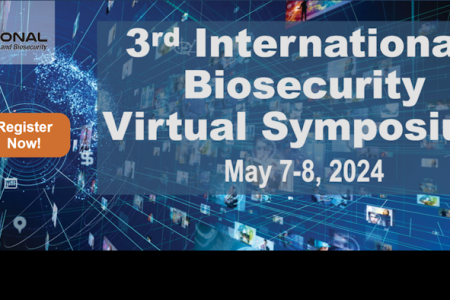
-
The basics of risk assessment
This online course is designed to provide attendees with a basic knowledge and requirements to complete risk assessments of laboratory activities.Read more
-
BBP workshop - Biocide Product Regulation and biosafety: new insights & future perspectives
One of the requirements of the 'contained use' legislation is the use of validated methods for inactivation of these GMOs and pathogens, the decontamination of work tables, etc. This is where the biocidal products regulation (BPR) comes in. However, for certain applications (e.g. inactivation of parasites, disinfection of water baths to heat up laboratory reagents), there are currently no authorised biocidal products available on the market.Read more